Enterprise Banking AI Orchestration Platform
An n8n-based AI orchestration system for banking that routes each request to the most suitable path: direct response, ML workflow, text-only LLM, multimodal VLM, vector RAG, or GraphRAG. The system chooses the lowest-cost path that still gives enough accuracy and evidence, helping automate bank document work, policy Q&A, fraud review, credit risk analysis, and other internal workflows.
Problem
Banking organizations operate across a broad set of information-driven processes, yet many AI assistants are still designed as a single generic interface sitting on top of a single model. That approach tends to break down in practice. Some requests are simple and transactional, some require policy or procedural grounding, some depend on cross-document reasoning, and others involve visually structured materials such as scanned PDFs, forms, tables, statements, and screenshots. Treating all of these scenarios as the same type of problem creates unnecessary cost, slower response times, weaker evidence handling, and limited explainability. In regulated and operationally sensitive environments, the real challenge is not merely generating fluent answers, but ensuring that each request is processed through the right capability, with the right level of grounding, and with enough contextual support to be trusted in day-to-day business use.
Approach
- The platform is implemented as an orchestration layer in n8n, where incoming requests are evaluated before any downstream model path is selected. This allows the system to interpret the task in business terms, considering complexity, modality, evidence needs, and operational intent as part of the routing decision.
- For straightforward requests, the platform can respond through a lightweight model or direct workflow path, reducing latency and avoiding unnecessary retrieval. This supports a more efficient operating model for routine internal interactions where speed and simplicity are more important than deep evidence expansion.
- When the request is primarily language-based and requires summarization, explanation, or reasoning over text, the platform routes it to an LLM path. For visually rich materials such as scanned documents, statements, reports, screenshots, forms, or tables, the platform shifts to a VLM path so that image and text signals can be interpreted together in a way that is more faithful to the source content.
- Where the task depends on internal knowledge, policies, operating documents, or institutional reference material, the platform activates a RAG layer to ground the answer in retrieved evidence. This supports stronger control over factuality and makes the response better suited to operational and compliance-oriented use.
- For more complex knowledge tasks involving linked definitions, policy exceptions, entity relationships, or reasoning across multiple connected sources, the platform extends retrieval through GraphRAG. The graph layer helps the system move beyond isolated semantic matches and surface the connected context that banking users often need in order to act with confidence.
- Because orchestration is handled centrally in n8n, the platform also supports rerouting, escalation, and workflow continuation. A lightweight path can be upgraded when confidence drops, a standard retrieval path can be expanded when broader context is needed, and final outputs can trigger downstream processes such as review flows, alerts, structured summaries, or integration with related operational systems.
Results
The platform delivers a more enterprise-ready AI operating model for banking by aligning intelligence to the actual nature of the request rather than applying one generic solution everywhere. This improves efficiency for simple interactions, strengthens grounding for document-based and policy-related queries, and provides deeper contextual coverage for knowledge-intensive tasks. In practical terms, the system is well positioned to support internal knowledge assistance, policy and procedure navigation, banking document operations, fraud review support, credit risk analysis workflows, and broader automation initiatives. From a product perspective, its core value lies in combining adaptability, governance, and explainability within a single architecture that is designed for real business environments rather than isolated AI demonstrations.
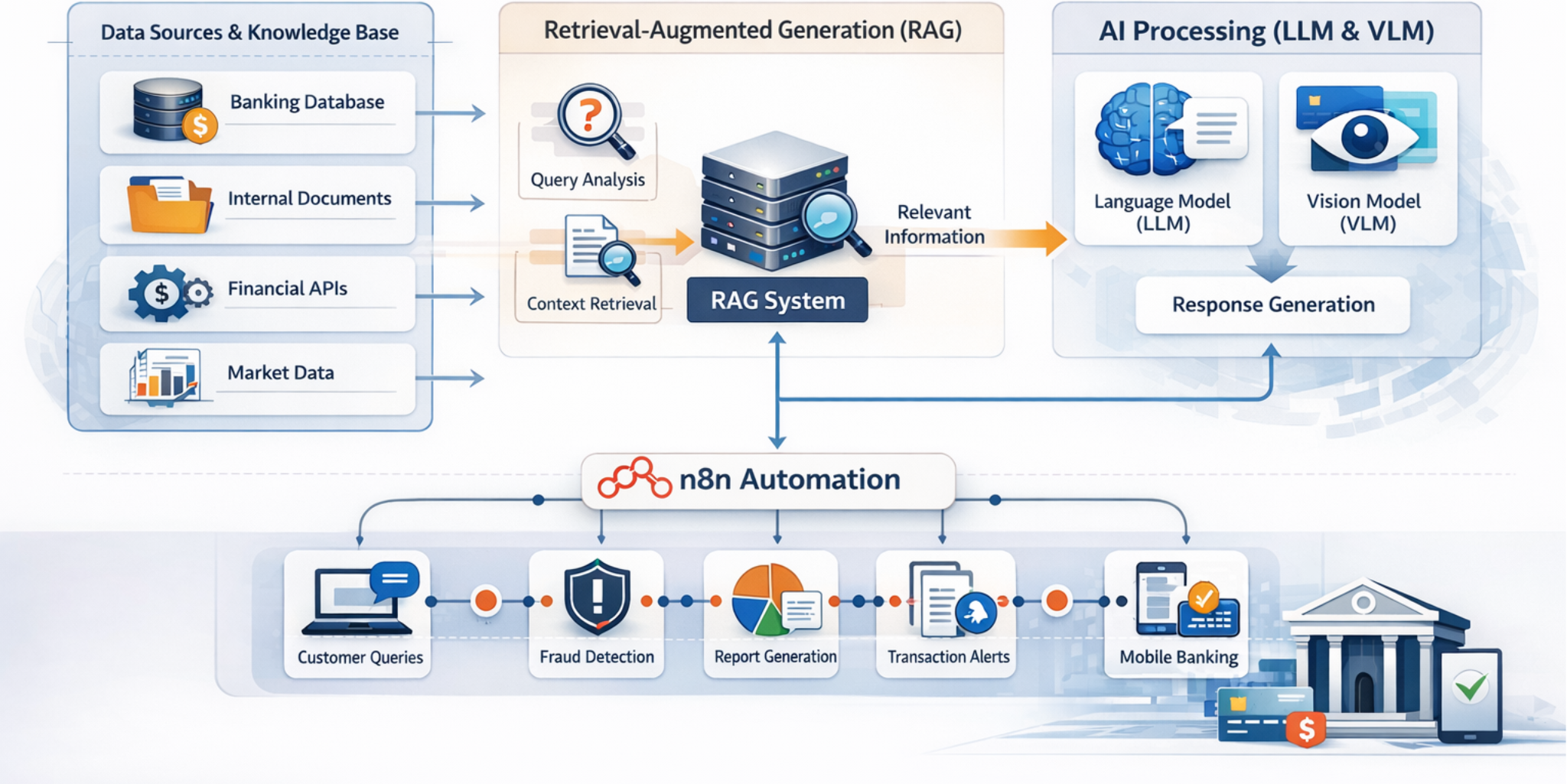
- Provides a unified orchestration layer for LLMs, VLMs, RAG, and GraphRAG in banking workflows.
- Routes requests according to business context, input modality, and evidence requirements to improve efficiency and answer quality.
- Supports production-oriented use cases across document operations, knowledge assistance, fraud review, credit risk support, and workflow automation.