← Back to projects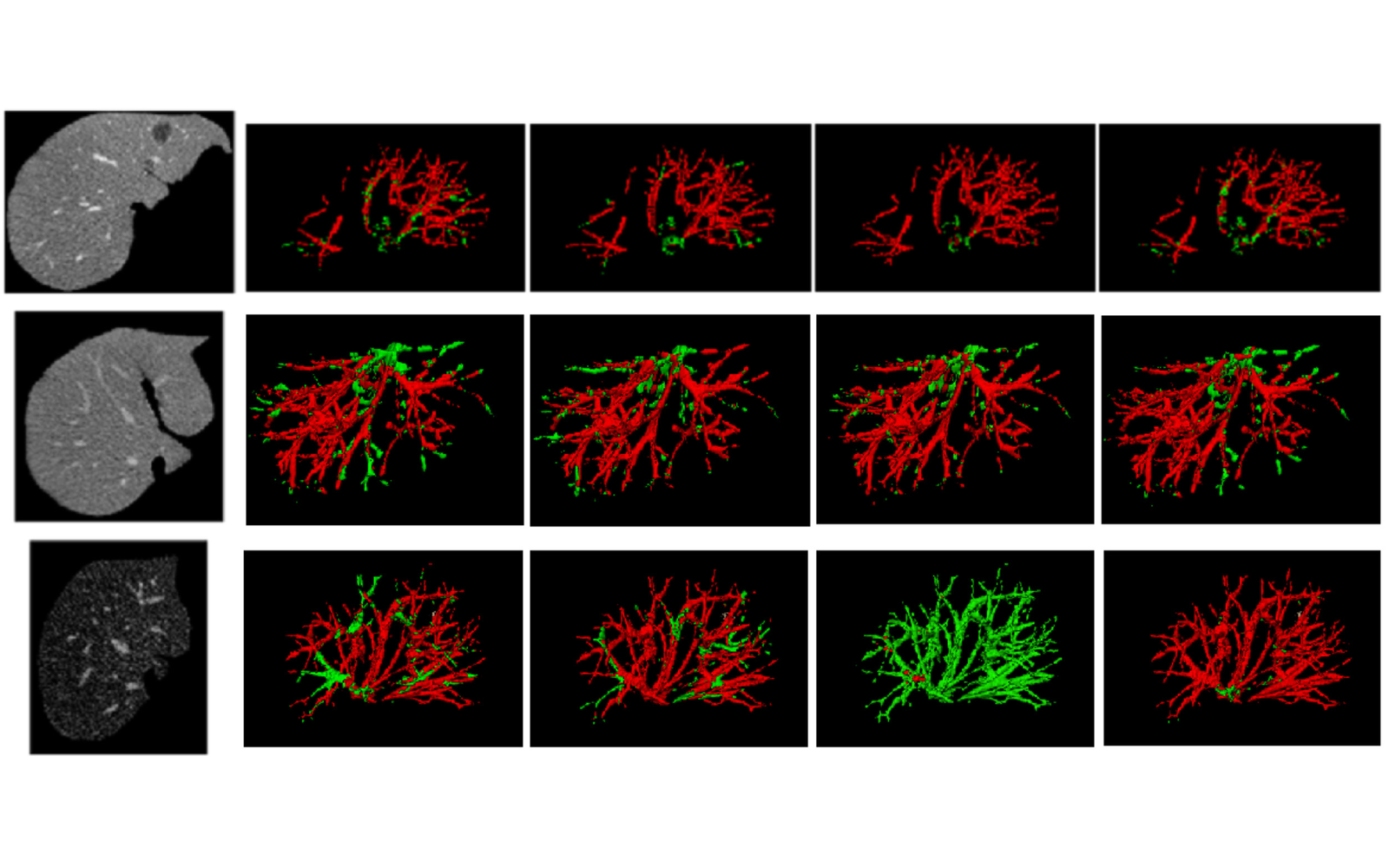
VesselNet: Vessel Imaging Segmentation System
This project presents VesselNet, a multi-pathway deep CNN for 3D hepatic vessel segmentation that classifies each voxel using three orthogonal 2D patches (sagittal/coronal/transverse) to better capture vessel structure in 3D.
Medical ImagingsegmentationSegmentationDeep learning
Problem
Hepatic vessel segmentation is difficult because vessels are thin/small, have low SNR, can be confused with liver tissue (similar intensities), and contrast/intensity ranges vary substantially across clinical scans while 2D methods often miss 3D continuity.
Approach
- Convert the raw volume into a vesselness probability map using a multiscale vesselness filter to normalize intensity variation across datasets.
- Perform patch-based voxel classification: extract 29x29 patches on three planes (sagittal/coronal/transverse) centered at each voxel; run them through three CNN pathways (DenseNet backbone), concatenate features, and classify with softmax (trained with negative log-likelihood).
- Apply a lightweight neighbor-weighted probability refinement as post-processing to reduce isolated noise and recover missed vessel voxels.
Results
Best configuration (DenseNet backbone) reaches Dice = 0.903, VOE = 17.2%, SEN = 0.929, PPV = 0.842, outperforming U-Net (Dice 0.723), V-Net (0.691), Frangi (0.664), and submodular graph cut (0.750).
Highlights
- "pre-highlights" the blood vessels before the AI starts
- Looks at 3 directions to avoid missing thin branches.
- Accurate, and stays reliable even with noisy data.